Journal of Case Reports and Reviews in Medicine (ISSN: 3069-0749)
Volume: & Issue:



















Volume: & Issue:
Introduction: Massive bee stings leading to severe anaphylaxis are rarely survived, with most documented cases especially those involving more than 200 stings resulting in fatality or lasting complications. This case highlights the impact of immediate intervention starting in the prehospital setting, and demonstrates that such incidents may occur even in urban environments.
Case Report: A 64-year-old man with no significant medical history presented after being attacked by a swarm of bees, sustaining over 200 stings while working outdoors in Rancho Mirage. He rapidly developed facial swelling, tongue swelling, dyspnea, diffuse rash, and hypotension. Epinephrine was administered by emergency medical services (EMS) at the scene, followed by intravenous fluids and diphenhydramine. On arrival, he appeared ill, with marked periorbital edema, numerous papular lesions, and hundreds of visible stingers. Prompt removal of stingers, repeated doses of epinephrine, along with corticosteroids, intravenous fluids, and antihistamines, led to rapid clinical improvement. Laboratory studies revealed high anion gap metabolic acidosis, hyperglycemia, and mild renal insufficiency. The patient was discharged in improved condition with epinephrine auto-injector and planned follow-up.
Conclusion: This case demonstrates that immediate recognition and guideline-based management of massive bee envenomation, starting in the prehospital setting, can be lifesaving. Emergency clinicians should recognize that such life-threatening envenomations may occur in urban as well as rural settings.
Keywords: bee sting, anaphylaxis, envenomation, emergency medicine, EMS
Massive bee envenomation causing systemic anaphylaxis is extraordinarily rare, with most similar cases in adults reported as fatal due to either delayed recognition or lack of rapid intervention.1-3 While the majority of bee stings result in mild, self-limited effects, exposures in excess of one hundred stings carry a dramatically increased risk for multi-organ failure, profound anaphylaxis, and death. Survival following hundreds of bee stings is seldom described in the literature and is typically associated with early, aggressive intervention.
This case is distinct in several aspects: (1) it documents full recovery in a previously healthy adult after more than 200 bee stings resulting in severe anaphylaxis, (2) it underscores the pivotal impact of real-time prehospital (EMS) recognition and epinephrine administration, and (3) it demonstrates the occurrence of a life-threatening bee sting emergency in a modern urban setting.
A 64-year-old man with no significant medical history was brought to the emergency department (ED) after being attacked by a swarm of bees and sustaining well over 200 stings while trimming trees in an urban area. Shortly after the incident, he developed marked facial swelling, mild dyspnea, tongue swelling, diaphoresis, and a diffuse red rash. EMS found him hypotensive (systolic blood pressure in the 70s) and immediately administered intramuscular (IM) epinephrine, followed by intravenous (IV) diphenhydramine and an IV normal saline fluid bolus, which rapidly improved his hemodynamic status.
On arrival to the ED, the patient was ill-appearing with significant periorbital and facial edema, widespread erythema across the scalp, torso, back, and extremities, and hundreds of punctate papular lesions (Image 1; Image 2; Image 4). A collection tray was quickly filled with stingers and a few dead bees as the care team meticulously removed more than 300 visible stingers (Image 3). All clothing was decontaminated for residual insects and stingers.
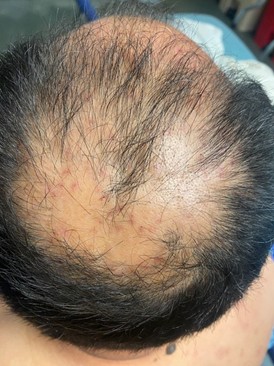
Image 1. Scalp displaying numerous punctate erythematous papules at sites of massive bee envenomation.
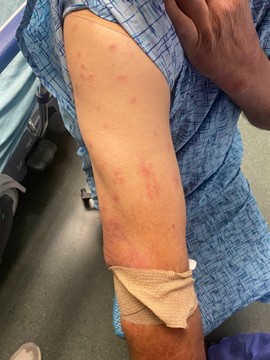
Image 2. Left upper extremity showing scattered erythematous papules from multiple bee stings.
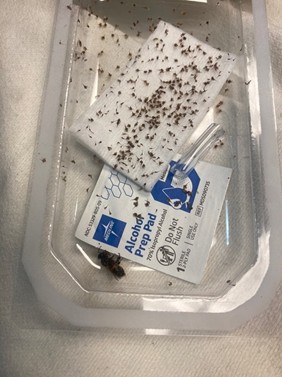
Image 3. Tray collection of over 100 extracted bee stingers and dead bees obtained from the patient upon arrival.
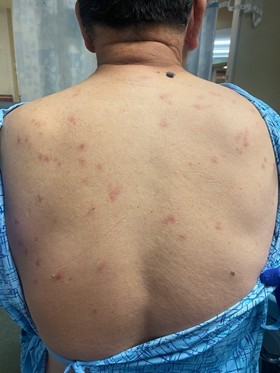
Image 4. Posterior torso with widely distributed erythematous papules after extensive bee stings.
Vital signs after initial resuscitation showed blood pressure 163/104 mmHg, pulse 82 beats per minute, respiratory rate 19 per minute, and oxygen saturation 99% on room air. There was no pharyngeal or uvular edema and no airway compromise. Physical examination otherwise revealed normal cardiopulmonary findings, a soft non-tender abdomen, and full orientation and normal mental status.
Laboratory findings included a high anion gap metabolic acidosis (CO₂ 16.1 mmol/L, reference: 22–29 mmol/L; anion gap 17, reference: 8–16 mmol/L), moderate hyperglycemia (glucose 200 mg/dL, reference: 70–99 mg/dL), and mild renal insufficiency (creatinine 1.3 mg/dL, reference: 0.7–1.3 mg/dL; eGFR 57.7 mL/min/1.73 m²).
Therapeutic interventions in the ED included a second IM dose of epinephrine (0.3 mg), additional IV famotidine, methylprednisolone, diphenhydramine, a 1,000 mL normal saline bolus, and IV fentanyl for analgesia. The patient’s clothing and belongings were fully decontaminated and serial examinations performed. Rash and edema improved over four hours. The patient remained non-hypoxic and hemodynamically stable throughout. He was discharged with oral diphenhydramine, an epinephrine auto-injector, and instructed to follow up with his primary doctor.
Prompt Removal of Bee Stingers
A key component of this patient's care was the immediate and systematic removal of all bee stingers, which were embedded throughout the scalp, face, back, and extremities. Each stinger was extracted using sterile tweezers immediately upon arrival, and all clothing and exposed surfaces were thoroughly inspected. This rapid action is crucial, as retained stingers can continue to deliver venom for up to 30 seconds or more after initial contact. The total venom dose is directly related to the duration stingers remain in the skin, increasing the risk of both local tissue injury and severe systemic reactions. Clinical evidence confirms that the speed of stinger removal is more important than the method prompt removal by any means is associated with improved outcomes and decreased severity of toxic and allergic complications.1,4 In this case, immediate stinger extraction likely minimized ongoing venom exposure and contributed to the patient's rapid reversal of anaphylaxis and absence of late organ dysfunction.
Massive bee envenomation leading to severe systemic allergic reactions is rarely reported and is usually associated with significant morbidity or fatality, particularly when more than 100 stings are involved.1-4,6 In most prior published cases, outcomes were poor due to delayed recognition, insufficient early intervention, or occurrence in locations where access to advanced care was limited. By contrast, this patient’s outcome highlights the critical importance of early intervention even in the prehospital setting as well as rapid, protocol-driven care upon arrival.
Comparison with Prior Literature:
Unlike previously described cases resulting in death or prolonged morbidity, this patient survived more than 200 bee stings and discharged from the ED the same day. Notable features include rapid EMS recognition and treatment with IM epinephrine, systematic stinger removal upon arrival, aggressive supportive care, and close observation.1-5 This case also challenges the perception that life-threatening bee envenomations are limited to rural or agricultural environments, as it occurred in the highly urbanized city of Rancho Mirage, California, U.S.A
Scientific Rationale:
Bee venom contains multiple biologically active components, including melittin, phospholipase A2, and hyaluronidase, each capable of causing direct cytotoxicity and triggering severe immunologic (IgE-mediated) responses. Massive venom delivery exacerbates both allergic and direct toxic effects, predisposing patients to cardiovascular collapse, metabolic derangements, and organ dysfunction. The best-established interventions rapid administration of epinephrine and prompt stinger removal limit both the allergic cascade and the overall venom burden, thus improving likelihood of survival.1,4,7
Strengths and Limitations:
This case report is notable for (1) the rarity and severity of massive bee envenomation in an adult with complete survival, (2) the stepwise, guideline-based management beginning in the prehospital setting, (3) detailed clinical and photographic documentation, and (4) direct discussion of urban exposure risk. Limitations include single-patient experience and lack of long-term follow-up laboratory data for delayed effects such as rhabdomyolysis or hepatic dysfunction.
Survival following more than 200 bee stings resulting in severe anaphylaxis is exceptionally rare. This case demonstrates that rapid recognition, immediate administration of IM epinephrine, aggressive stinger removal, and protocol-driven supportive care beginning even before hospital arrival are critical to achieving favorable outcomes. Clinicians should be aware that such emergencies can occur in both urban and rural environments and be prepared for prompt intervention.
Conflicts of Interest: None declared.
Grants: No funding or grants were received for the preparation of this manuscript.
Acknowledgments: None at this time.